For you
Put them in.
Walk.
That's all you do. The insoles measure the rest — for a few months, or for years.
Recovering from surgery, training hard, or simply intending to still be walking well in twenty years.
Nobody tells you
if you're doing it right.
Too little weight and you stiffen up. Too much and you push it. Between appointments — whether that's three weeks or six months — you're guessing.
When it's worn
Before surgery. After it.
And for as long as needed.
A real baseline
Measured load from daily life, so the plan starts from evidence rather than one corridor walk.
Progress, day by day
Loading, symmetry and roll-off quality advancing together — and a visible change in the trend when they are not.
The long watch
For feet that carry a lot or need watching over time — a continuous record of how load is shared and how the pattern drifts.
What changes
You get an answer
every single day.
Am I balanced?
See how weight is shared between your feet, and watch it change.
Am I on plan?
Loading, roll-off, footprint and symmetry — see whether what you were asked to work towards is what you are actually doing.
Is anything changing?
A trend line, not a feeling. Something concrete to bring to your next appointment — or a reason to move it earlier if things are slipping, and later if they are not.
Stride One Score
Day 214One score, three questions
The Stride One Score.
One number to follow, built from three that explain it.
Balance Index
Are you using the foot?
How weight is shared between left and right — in force and in time. The number that shows whether one side is still being protected.
Roll Index
Are you using it well?
The quality of the transition from heel, through midfoot, to push-off — the movement people avoid longest.
Footprint Index
Where does the load sit?
How load is distributed across the zones of each foot, how the two maps compare with each other, and how both shift from one month to the next.
Change, made visible
Stop guessing.
Every week you can see where you are, and how far it still is to where you're heading.
You steer it.
Seeing the numbers is what lets you calibrate: how much to load today, whether you're keeping to what was agreed, and which part of the step still needs practising.
You share it.
The same record goes to whoever you choose — your surgeon, your podiatrist, your physio, or the family keeping an eye on you. The next appointment starts from every week since the last one, not from twenty minutes of memory.

Without these insoles, you're blind as to how quickly you are going from non-weight-bearing to full weight-bearing.

Seeing my Stride One data every day keeps me motivated and gives me real insight into my recovery.
Pauline
After my surgery I had to relearn to walk. Stride One’s daily insights let me see my own progress, which made me very enthusiastic.
CindyAs easy as
putting in an insole.
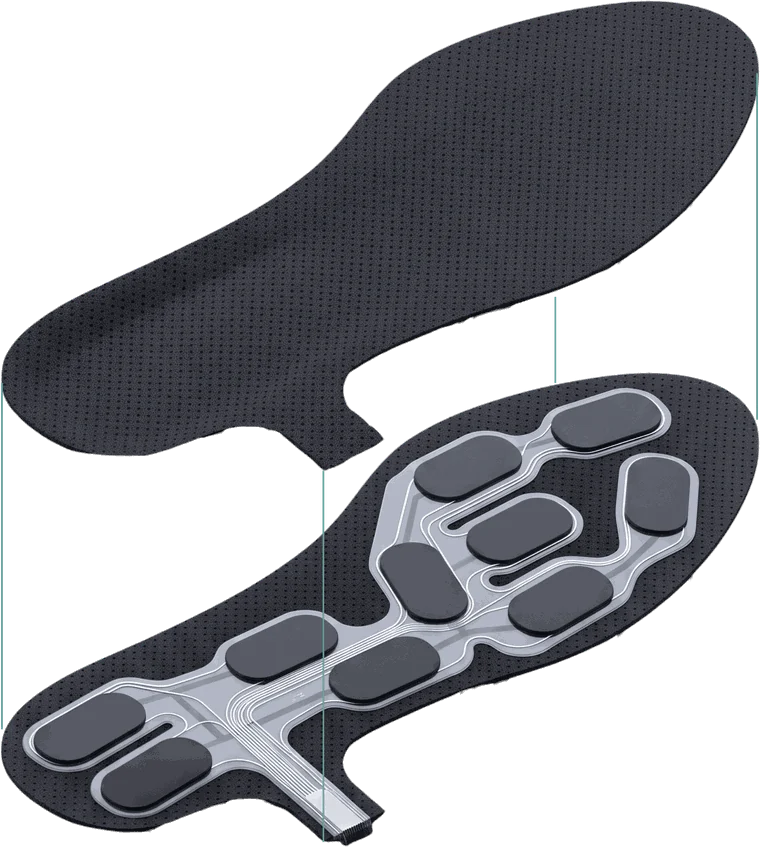
Because that is all it is. Two millimetres thin, in your size, sitting on top of or underneath the insoles of the shoes you already wear — trainers, work boots, a post-op shoe.
Recording begins when you move and stops when you stop. No session to open, nothing to log.
The sensor array reads the whole foot continuously while you walk.
Open the app and press download so the day’s recordings upload. Charge overnight.
Scan the code once and it pairs. After that you only open it when you want to look.


One minute to set up.
Then it's automatic.
Plug them in
A USB-C cable wakes the insoles up. That is the on switch.
Scan the code
The app installs, you sign in, and the insoles connect.
Into your shoes
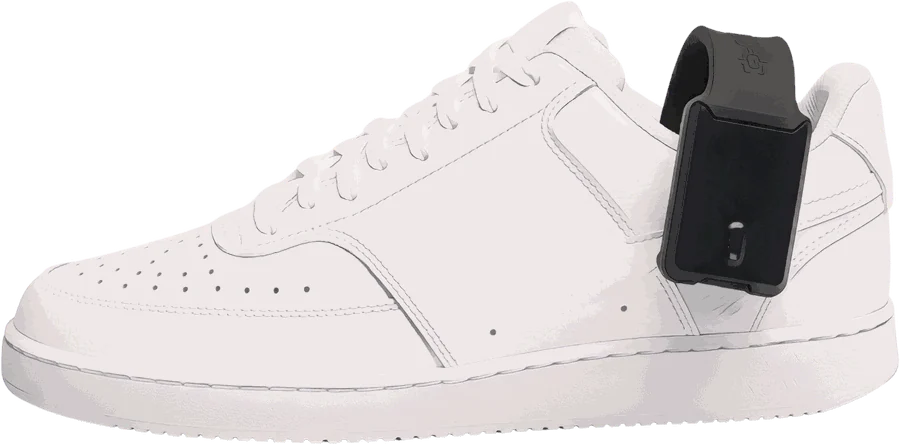
On top of or underneath your own insoles, lying flat, housing clipped to the shoe.
Walk
Nothing to press while you walk. It records when you move, sleeps when you stop.
After that, two quick things a day: open the app and press download so the recordings upload, and charge the insoles overnight.
Want the research behind all this? Why step count doesn’t show recovery, how long gait takes to recover after ankle surgery, and the rest of the evidence pages.
Showing it to your surgeon or physio? What to bring, and how to explain it in a minute.
How much work is this?
Ten seconds a day.
That's the whole job.
Plug them in, scan the code, slide them into your shoes.
Open the app, press download. Charge them overnight.
There is no session to start and nothing to press while you walk. They record when you move and sleep when you stop.
What arrives, and what it costs
One payment.
No subscription.
€299
Normally €399
Shipping included. Two-year guarantee.
For hygiene reasons, insoles cannot be returned once the seal is broken.
Order Stride One →A pair of insoles in your size, the charging cable, and the clip-on housing.
Your Stride One Score each day, and the three indices behind it: Balance, Roll, Footprint.
The full record, yours to share with whoever you choose.
Plainly
What Stride One does —
and what it doesn’t.
It does
Measure how load is shared between your feet, how you roll through each step, and where pressure sits across the foot — continuously, in your own shoes, for as long as you wear them. It gives you and anyone you share it with a record of how that changes.
It doesn’t
Diagnose anything, detect any condition, or tell you what to do about what it shows. It does not measure skin temperature. It does not replace an appointment, an examination or your clinician’s judgement.
What the published research actually shows: why step count doesn’t tell you if you’ve recovered, how well patients really follow weight-bearing instructions, and the rest of the evidence pages.
Ready when you are.
Pick your size, tell us where to send them, done. No waiting for a call back.
Questions first? Write to info@ceriter.com
Will they fit my shoes?
They sit on top of or underneath the insoles you already have, so they fit most normal footwear. A small housing clips onto the outside of the shoe.
What size do I need?
You will get a size guide while you order, so you can pick the right one before you check out.
Is it tracking where I go?
No. It records how you walk, not where. It is shared only with the clinicians — or the family — you choose to share it with.
How long do I wear them?
That is up to you. Around an operation, starting a few weeks beforehand gives a baseline worth comparing against, and most people keep going until their recovery is done. If you are wearing them to train better, to protect a foot that takes a lot, or simply to keep an eye on how you walk as the years go by, there is no end date — the longer the record, the more it tells you.